
Last updated: 2026-06-02
Sources reviewed: This comparison uses SAFVR product materials and public SoterAI pages reviewed on June 2, 2026, including the SoterAI homepage, workplace ergonomics page, ergonomic assessment software page, and Covia case study. Product pages change; verify current vendor capabilities during procurement.
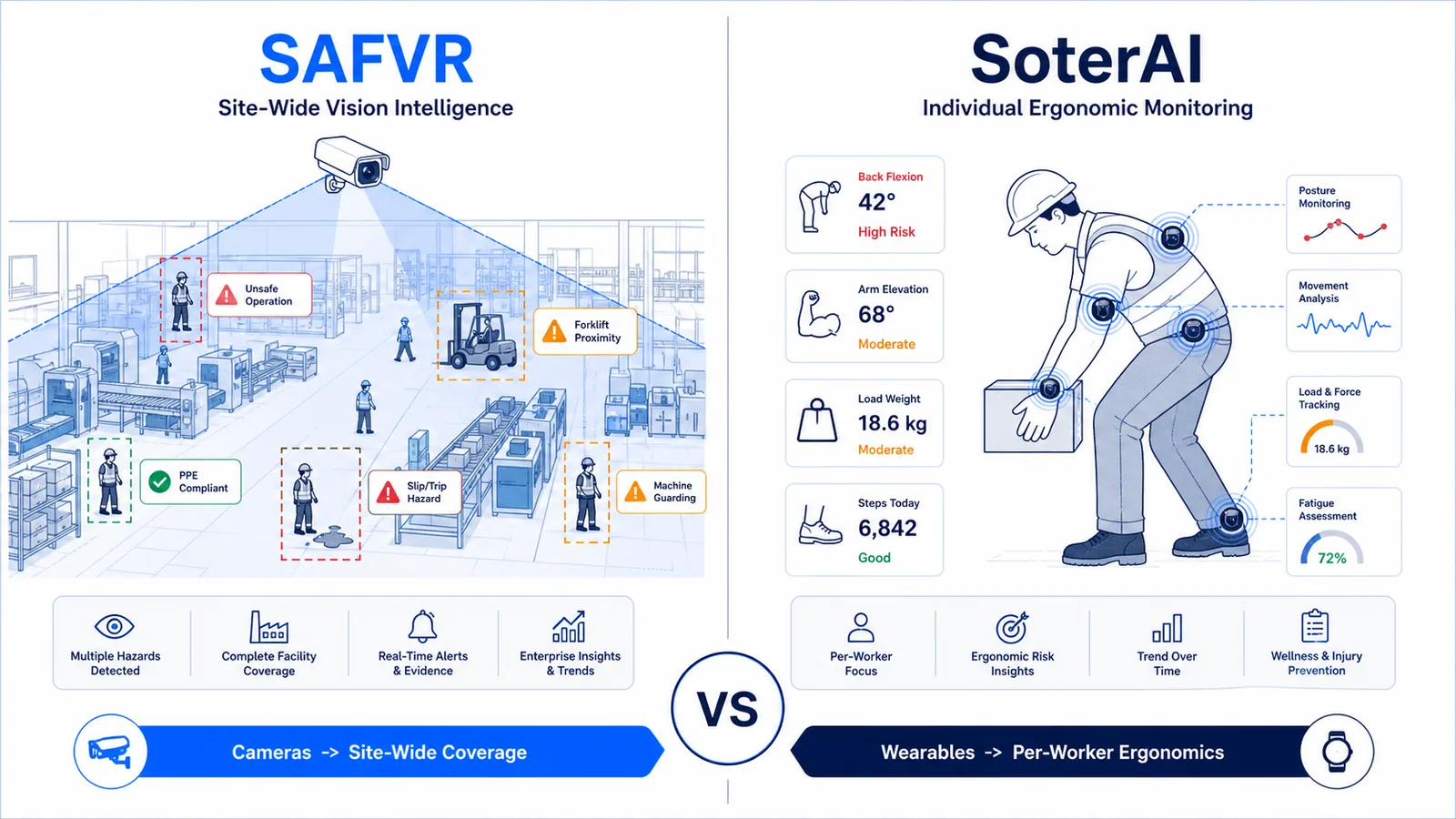
Quick Answer: SAFVR and SoterAI solve overlapping but different safety problems. SoterAI publicly positions itself as an AI-powered loss prevention and workplace safety platform with guided workflows, records, risk intelligence, and ergonomics assessment. SAFVR uses existing site cameras to detect unsafe acts and conditions across camera-visible zones, then automates workflows, delivers micro-training, and surfaces predictive risk patterns. Choose based on the risk source: task-level assessments and administrative workflow automation versus live camera-based site intelligence and closed-loop detection-to-action workflows.
When EHS leaders evaluate AI-powered safety platforms, the choice often narrows to the evidence source: camera-based site intelligence, task-video or phone-based assessment, workflow automation, and, in some Soter materials, wearable coaching. The critical question for buyers is: What type of risk are you trying to reduce, and what data source is acceptable for your workforce and privacy model?
This is not a winner-takes-all comparison. SoterAI has public materials around loss prevention, safety workflows, records, insurance, and ergonomics. SAFVR operates as a camera-based safety intelligence platform. This guide compares the two across evidence source, workflow automation, training, predictive intelligence, deployment, and privacy.
At a Glance: SAFVR vs SoterAI
| Dimension | SAFVR | SoterAI |
|---|---|---|
| Core Technology | Computer vision + existing IP cameras | Public SoterAI materials describe AI safety workflows, records, phone-video ergonomics assessment, and loss-prevention intelligence |
| Coverage Model | Camera-visible zones and connected workflows | Assessment, workflow, and portfolio coverage varies by SoterAI module and customer scope |
| Primary Risk Focus | Unsafe acts & conditions, PPE violations, restricted-zone entry, vehicle-pedestrian proximity | Public SoterAI materials emphasize loss prevention, safety admin reduction, records, insurer workflows, and ergonomics |
| Detection Method | Passive monitoring via cameras, scoped by camera coverage | Public SoterAI ergonomics pages describe task video or conversational assessment; legacy case studies also reference SoterCoach wearable programs |
| Workflow Automation | Automated alerts, permit-to-work triggers, compliance actions | Public SoterAI materials describe guided workflows, action ownership, records, and exports |
| Training Delivery | Site-specific micro-training from detected incidents | Verify current SoterAI training and coaching workflows directly with the vendor |
| Predictive Layer | Leading indicators across shifts, sites, and time periods | Public SoterAI materials describe portfolio risk intelligence and patterns across safety data |
| Deployment Model | Software + existing camera integration (no rip-and-replace) | SoterAI deployment depends on selected workflows and data sources |
| Privacy Model | Camera-based, requiring privacy-by-design framing | Assessment/workflow data model varies by SoterAI module; confirm worker data, video, and retention terms |
| Best Fit For | Facilities with existing cameras, multi-hazard environments, sites needing closed-loop safety intelligence | Teams prioritizing safety workflow automation, records, loss-prevention reporting, and ergonomics assessment |
Based on public vendor positioning reviewed June 2, 2026. Validate details in a live pilot and contract review.
Detection Approach: Site-Wide Vision vs Workflow and Ergonomics Assessment
The biggest difference is what gets monitored and how.
SoterAI: Safety Workflows and Ergonomics Assessment
SoterAI's current public website presents a broader AI-powered loss-prevention platform. Its ergonomics pages describe turning phone video or task descriptions into scored assessments and owned controls. Some public case studies also reference SoterCoach wearable programs. Confirm which product module, hardware, and data source applies to your use case.
Strengths to validate from public materials:
- Guided safety workflows and records
- Phone-video or task-based ergonomics assessment
- Portfolio and loss-prevention reporting for safety and insurance teams
- Publicly stated safety-specific AI data and security posture
Questions to validate in procurement:
- Which use cases require worker video, wearable data, or only forms and records?
- Which hazards are assessed from uploaded media versus monitored continuously?
- What employee notices, retention controls, and worker privacy settings are available?
SAFVR: Site-Wide Vision Intelligence
SAFVR's AI hazard detection layer uses computer vision running on existing IP cameras to monitor entire work zones simultaneously. It detects unsafe acts & conditions — such as missing PPE, restricted-zone breaches, vehicle-pedestrian near-misses, and environmental hazards — without requiring workers to carry anything.
Strengths (pilot benchmark and anonymized deployment data):
- Covers every camera-visible zone simultaneously
- Detects environmental, equipment, and multi-person hazards
- No per-worker hardware logistics
- Enables near-miss detection before incidents occur
Limitations:
- Requires adequate camera coverage; blind spots exist
- Performance depends on lighting, angle, and image quality
- Does not measure internal biomechanical strain
- Requires thoughtful privacy communication
SoterAI answers: "Is this worker moving in a way that risks ergonomic injury?" SAFVR answers: "What unsafe acts and conditions are happening across this site?" These are complementary questions.
Inline CTA: Still evaluating your options? See our full SAFVR vs SoterAI comparison page or start a 30-day safety intelligence pilot to test site-wide detection on your existing cameras.
Action & Workflow Automation
Detection without action creates alert fatigue. The critical question is how each platform turns detections into accountable responses.
SoterAI: Guided Workflows to Validate
Public SoterAI materials describe guided safety workflows, records, action ownership, exports, and ergonomics assessment. During procurement, validate which workflows are native, which are configured by use case, and whether any worker-facing feedback depends on a specific module or data source.
SAFVR: Automated Safety Workflows
SAFVR's safety compliance automation layer turns detections into multi-step, accountable workflows: alerting supervisors, triggering permit-to-work holds, logging video evidence, assigning follow-up actions, and initiating site-specific micro-training. Every detection becomes a trackable event that integrates with existing EHS systems.
Comparison Summary
| Capability | SoterAI | SAFVR |
|---|---|---|
| Real-time worker notification | Verify by module and data source | Supervisor/worker alerts where scoped |
| Individual coaching loop | Verify current coaching workflows | Incident-based micro-training where scoped |
| Automated compliance actions | Verify native versus exported workflows | Permit triggers, holds, and re-verification where scoped |
| Incident logging with evidence | Verify record type, retention, and export depth | Video evidence and metadata where camera coverage allows |
| Integration with EHS systems | Verify connector depth | Designed for integration |
Based on public vendor positioning reviewed June 2, 2026. Validate in a same-scope pilot.
Training & Learning Loop
Both platforms recognize that detection alone does not change behavior. The training layer determines whether insights actually reduce future risk.
SoterAI: Coaching and Training Workflows to Validate
Public SoterAI materials reviewed for this page emphasize safety workflows, records, loss-prevention intelligence, and ergonomics assessment. If training content, worker coaching, or event-triggered learning is part of your use case, validate the current workflow, data source, and reporting depth directly with SoterAI.
SAFVR: Incident-Based Micro-Training
SAFVR's incident-based micro-training engine generates short, site-specific modules from actual detected events. If a worker enters a restricted zone without PPE, the system assigns a 3-minute refresher tied to that incident — using the facility's own layout and procedures. Delivery is multilingual, completion is tracked, and training data feeds the predictive layer (customer-reported).
| Training Dimension | SoterAI | SAFVR |
|---|---|---|
| Training trigger | Verify by module and data source | Detection event -> automatic assignment where scoped |
| Content scope | Verify current content and coaching coverage | Site-specific hazards, PPE, procedures |
| Personalization | Verify current personalization model | Individual incident history and role where scoped |
| Delivery method | Verify current delivery workflow | Short modules and quizzes where scoped |
| Multilingual support | Verify current language support | Designed for multilingual delivery |
Predictive Intelligence
The highest-value platforms do not just react — they help prevent. Predictive capabilities separate compliance tools from intelligence platforms.
SoterAI: Risk Intelligence to Validate
Public SoterAI materials describe portfolio risk intelligence and patterns across safety data. During evaluation, confirm which risk signals are predictive, which are descriptive, and how reports connect to specific controls, claims, or insurance workflows.
SAFVR: Site-Level Leading Indicators
SAFVR's predictive safety intelligence correlates detection data across shifts, zones, and time periods. Patterns include PPE non-compliance spikes after shift changes (pilot benchmark), near-miss clustering in low-visibility zones (anonymized deployment), and repeat unsafe acts tied to specific crews (customer-reported). This enables proactive intervention and produces structured leading indicator reports for risk-review conversations.
Deployment Models
Deployment differs significantly in timeline, logistics, and management.
SoterAI: Module-Dependent Rollout
SoterAI deployment depends on the selected module, data source, and workflow scope. Public materials reviewed for this page describe AI workflows, records, phone-video ergonomics assessment, and legacy case-study references to wearable programs. Confirm current hardware, video, data-retention, and onboarding requirements directly with SoterAI.
SAFVR: Software-First Integration
Deploying SAFVR means connecting to existing IP cameras (no rip-and-replace), configuring detection rules and zone definitions, integrating alert channels, and calibrating models to the facility's hazards. No worker-facing hardware is required. A 30-day safety intelligence pilot is available for validation before full rollout.
Privacy & Worker Acceptance
Both approaches carry privacy considerations EHS leaders must address transparently.
SoterAI: Module-Specific Worker and Assessment Data
SoterAI's privacy posture depends on the selected module and data source. For any workflow involving worker video, ergonomic assessment data, wearable data, or named safety records, confirm data ownership, disciplinary-use restrictions, retention, access controls, and employee notice requirements.
SAFVR: Camera-Based Monitoring
Camera-based detection observes work zones, not individuals by default. Concerns include perceived surveillance, permanent video records, and regional regulations such as GDPR or state biometric laws. Best practice (customer-reported and third-party guidance): position as hazard detection and worker protection, avoid non-work areas, use redaction and restricted access, and engage works councils early.
The Acceptance Dynamic
Wearables can feel intrusive ("my body is being measured"). Cameras can feel watchful ("I am being watched"). Neither is automatically easier to implement. Success depends on communication, policy clarity, and demonstrated worker benefit — fewer injuries, fairer investigations, and safer conditions.
Which Platform Fits Your Use Case?
Honest evaluation requires matching platform architecture to your dominant risk categories and infrastructure.
Choose SoterAI If:
- Primary injuries are musculoskeletal, back, or repetitive strain
- You operate in warehousing or logistics where manual handling dominates
- Workforce is stable and device logistics are manageable
- You want individual ergonomic coaching, not site-wide hazard detection
- You want to evaluate a workflow or ergonomics-assessment program before expanding camera coverage
Choose SAFVR If:
- You need site-wide coverage of unsafe acts & conditions, PPE, and environmental hazards
- You operate in manufacturing, oil & gas, construction, or heavy industry
- You have existing IP cameras to leverage
- You need automated workflows, incident evidence, and compliance tracking
- You want predictive leading indicators and structured risk-review reports
- You need a closed-loop system: detection → action → training → prevention
Consider Both in a Layered Program
In large operations, these approaches complement each other. Cameras provide site-wide situational awareness; wearables provide individual ergonomic coaching. Start with the risk category causing your most costly incidents, then layer in the second approach.
Ready to evaluate site-wide safety intelligence? Request a demo to see SAFVR's detection and automation capabilities on your existing camera infrastructure, or start a 30-day pilot to validate results before full commitment.
Frequently Asked Questions
Can SAFVR and SoterAI be used together?
Yes. They monitor different risk categories through different architectures. SAFVR covers site-wide hazards via cameras. SoterAI covers individual ergonomic risk via wearables. Large facilities with both environmental hazards and high manual-handling workloads may benefit from a layered approach. (Assessment based on architectural analysis.)
Does SAFVR require workers to wear devices?
No. SAFVR uses existing facility cameras for passive monitoring. Workers do not carry or wear any SAFVR hardware. This eliminates per-worker device logistics but requires adequate camera coverage. (Product documentation.)
Does SoterAI detect PPE violations or environmental hazards?
The public SoterAI sources reviewed for this page emphasize loss-prevention workflows, records, ergonomics assessment, and safety intelligence. I did not find a public SoterAI source in this review that clearly claims continuous live CCTV detection for PPE, restricted-zone entry, spills, or vehicle-pedestrian interactions. Verify current capabilities directly with SoterAI before using this as a selection criterion.
Which platform is easier to deploy?
It depends on your existing infrastructure, selected modules, worker data requirements, camera coverage, and integrations. SAFVR deploys through camera and workflow integration where scoped. SoterAI rollout should be confirmed directly from the current module and data-source requirements.
How does pricing compare between SAFVR and SoterAI?
Neither platform should be evaluated from assumed pricing. SAFVR scopes pilots and subscriptions by camera, site, integrations, and deployment model. SoterAI pricing should be confirmed directly from current SoterAI sales materials. Exact comparison requires the same facility, use cases, and support assumptions.
Conclusion
SAFVR and SoterAI are different answers to different safety questions. Public SoterAI materials emphasize safety workflows, records, loss-prevention intelligence, and ergonomics assessment. SAFVR delivers Site-Specific Safety Intelligence through camera-based detection, workflow automation, and predictive analytics for multi-hazard industrial environments.
The right choice depends on your injury profile, infrastructure, and whether your priority is individual movement correction or site-wide hazard intelligence. For many operations, the long-term answer may be both.
If you're evaluating a SoterAI alternative that expands beyond ergonomics, start a 30-day pilot or request a demo.
Related Reading
- SAFVR vs Intenseye Comparison — How SAFVR compares to another camera-based detection platform with a focus on OSHA compliance.
- PPE Detection AI Guide — A deep dive into camera-based PPE compliance monitoring and how to evaluate vendor capabilities.
- How to Evaluate a Safety Intelligence Platform — Use this 10-capability scorecard to compare any safety platform objectively.